The warmth inside an angora jumper
Angora wool is a fibre spun from the guard hairs of the angora rabbit, and an angora wool jumper is a knit garment that blends those soft, hollow hairs with 50 to 65 percent merino wool so the finished sweater keeps the loft and warmth of the rabbit hair while staying strong enough to hold its shape. The blend works because the angora fibres trap 3 to 4 times as much still air as a wool hair of the same thickness, and that air is what keeps the body heat in. This page follows that mechanism from a single fibre to a finished garment, across jumpers, cardigans, hats and gloves, and settles which fibre wins in which cold.
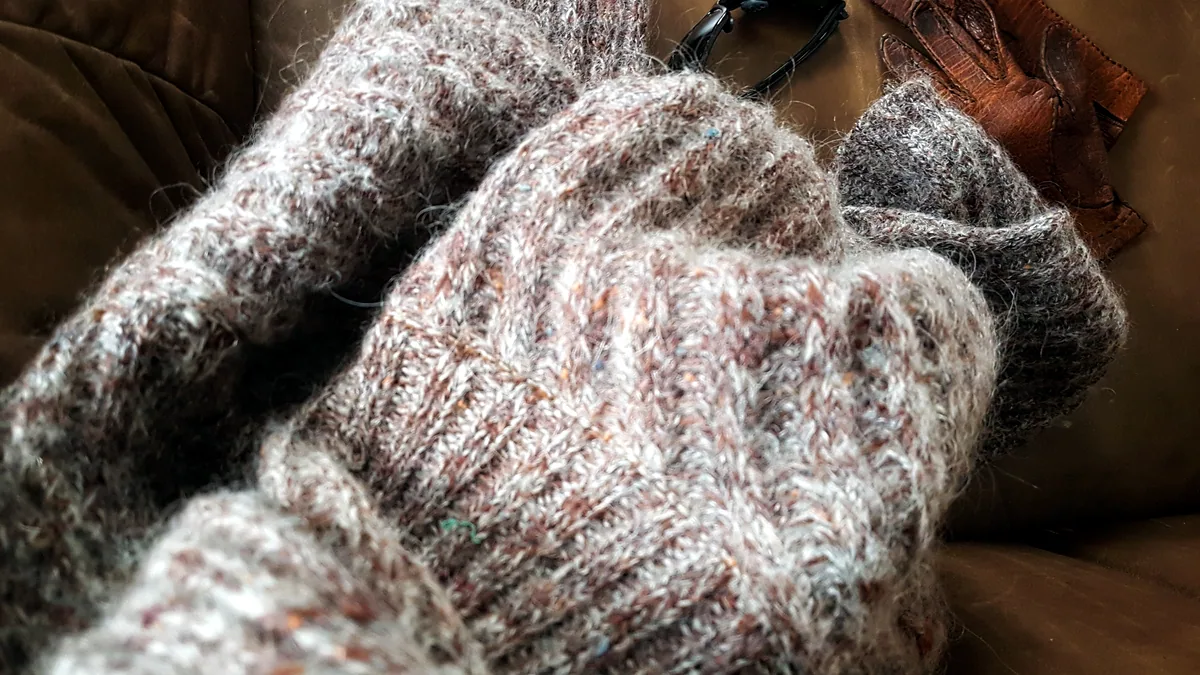
The rabbit hair is not a separate warm layer; it is woven into the wool body of the knit, and that mix is what makes the garment hold 3 to 4 times more trapped air than a solid wool sweater. How thermal underwear works on the same principle, because the underlayer only needs to hold a thin layer of dry, still air, and the heated version, Thermal underwear heated by a battery, removes the fibre question altogether. Two other blends sit on the same ladder, so the comparison runs from Angora and wool on the soft end to the mohair example below, Why a mohair jumper keeps its loft, because the fibre family decides how much air a knit can hold before it settles.
What an angora wool jumper actually is
An angora wool jumper is a knitted sweater in which the angora guard hair is blended into a wool base, usually merino, at 10 to 50 percent by weight. The pure version, 100 percent angora, exists, but it pills fast and drapes, so the 30 percent blend is the standard for a daily jumper. The same fibre, spun the same way, makes the rest of the wardrobe: an angora wool cardigan gets the same loft in an open front, and an angora wool hat and a pair of angora wool gloves take the same yarn into a tighter gauge. In the uk, where the fibre trade is long established, these pieces are the winter line of the same mill run.
The structure that traps heat
The structure that traps heat is the fibre itself, and it is visible only under a microscope. A merino wool hair is a keratin shaft about 19 micrometres across, with a cortex that holds crimps and a medulla that is often absent in the fine grades. An angora guard hair is a tube about 12 micrometres across that stays hollow through its core, and that hollow core is where the air sits. The rabbit is bred to shed this guard hair once a year, so the fibre arrives clean and even, and the mill spins it into a yarn that holds its loft for a season. The table below puts the four fibres that decide this page side by side.
| Fibre | Typical diameter | Core | Warmth per gram | Softness |
|---|---|---|---|---|
| Angora (rabbit) | 12 micrometres | Hollow | 10 of 10 | 10 of 10 |
| Merino wool | 19 micrometres | Solid, crimped | 7 of 10 | 8 of 10 |
| Mohair | 40 micrometres | Hollow | 6 of 10 | 5 of 10 |
| Polyester fleece | 15 micrometres | Solid | 8 of 10 | 6 of 10 |
Why an angora jumper feels softer than a wool one
Why an angora jumper feels softer than a wool one comes down to diameter and surface, both of which the rabbit hair wins. At 12 micrometres, the angora hair is finer than a 19 micrometres merino, and the human hand reads fineness as softness before it reads anything else. The hollow core also bends without compressing, so the hair springs back to a smooth line instead of standing up. A 100 percent angora cardigan drapes like a knit silk, and a 30 percent blend keeps the wool structure with the rabbit surface, which is the trade the mill makes when it spins the yarn. The softness is real, and it is the reason the jumper feels warm at the moment you put it on, before the trapped air does its work.
Is angora warmer than wool
Is angora warmer than wool, and the answer is yes, per gram of fibre, but the difference shows up in a like-for-like knit, not in a heavier wool sweater. Per gram, the angora blend holds 3 to 4 times more still air than a solid wool knit of the same gauge, so a 450 gram angora-wool jumper holds as much heat as a 1,400 gram solid wool one. What is warmer than wool, then, is a hollow fibre in a fine gauge: angora, mohair, and a good cashmere all sit above merino on warmth per gram. What is not warmer than wool is a fleece that the body damps out, and that is the next section, which settles the fleece versus wool question a searcher keeps asking.
Which is warmer, fleece or wool
Which is warmer, fleece or wool, and the answer is wool, for a dry, still layer, while fleece wins in wet and windy conditions. A polyester fleece holds 8 of 10 on warmth per gram when it is dry, but the polymer is hydrophobic in a way that lets it wick and hold moisture against the skin, so a damp fleece gives up its warmth fast. A merino wool layer holds 7 of 10 dry and stays useful when damp, because the cortex absorbs moisture vapour without feeling wet. An angora wool blend sits at the top of the warm, dry, still range, which is the exact condition a jumper wears indoors and on a dry walk. The rule of thumb is: wool for the still layer, fleece for the wind, and the angora-wool blend for the dry and the warm.
Which garment the fibre wins
Which garment the fibre wins depends on the gauge, the shape and the air gap the design leaves. The list below covers the four pieces that use this yarn and the condition each one is built for.
- A jumper at 30 percent angora for a dry 5 C to 10 C walk, where the loft is the whole argument
- A cardigan at 30 percent angora for indoor warmth, where the open front lets the air circulate
- A hat at 50 percent angora for a 0 C to 5 C day, where the crown loses the most heat
- Gloves at 20 percent angora for a 5 C to 10 C day, where the hand needs strength as well as warmth
The pattern across the four is the same: the finer and the loftier the yarn, the better it is in the still, dry cold, and the heavier the wool share, the better it is against wind and damp. A jumper that is too much angora drapes and pills, and a hat that is too much wool scratches the crown, so the blend ratio is the design decision, not an accident. The mill spins the yarn to the ratio, the knitter sets the gauge, and the garment does the rest.