Bed socks in angora and mohair
Mohair bed socks are knitted foot coverings made from the long, lustrous fibre of the Angora goat, prized for a 240 gram weight class that delivers more warmth per gram than any other natural animal fibre, and for a loft that traps air so effectively a pair can hold the foot at a stable temperature through an entire 8 hour night of sleep. Alongside mohair, angora rabbit hair and merino wool form the two fibres that most bed-sock makers reach for, and the choice between them depends on the specific thermal and comfort properties each one brings to a garment that sits close to the skin for hours at a time.
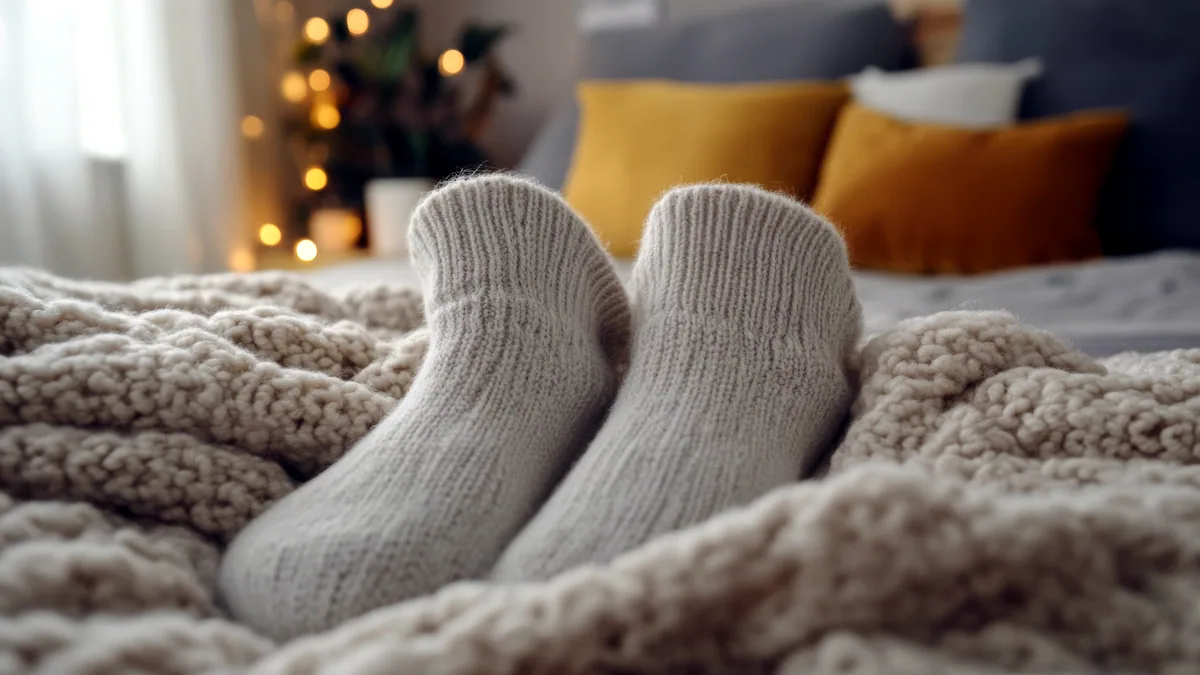
The structure of angora rabbit hair is what sets it apart from the other two: each hair shaft carries a hollow cortex that acts as a tiny insulating chamber, and a 19 mm diameter hair traps roughly 3 times as much still air as a solid shaft of the same thickness. The warmth inside an angora jumper comes from exactly that hollow-channel architecture, and the same physics governs a bed sock. Thermal underwear heated by the body works on the same principle: a layer of trapped air between the skin and the outside air slows conductive heat loss, and the denser that air pocket is, the lower the rate of heat escape. How thermal underwear works, in short, is a matter of building a thicker, more stable air layer than a single solid fabric could manage. Angora for thermal layers adds a second advantage, because the crimp in the fibre keeps the yarn from compressing flat under the weight of a duvet, so the insulation persists all night rather than collapsing by 4 a.m.
What Mohair and Angora Fibre Are
Mohair and angora fibre come from two different animals that share a common ancestor, and the difference in hair length and shaft structure is what separates the two socks on the shelf. Mohair is the coat of the Angora goat (Capra hircus), a breed that has been raised for its fibre for over 3,000 years in the highlands of Turkey, the Caucasus and parts of Central Asia. Angora rabbit hair, by contrast, is harvested from the Angora rabbit (Oryctolagus cuniculus), a domesticated breed developed in the region around Ankara, Turkey, where the name itself comes from.
| Property | Mohair (Angora goat) | Angora rabbit hair | Merino wool |
|---|---|---|---|
| Typical fibre diameter | 22 to 30 micron | 7 to 16 micron | 15 to 24 micron |
| Hollow cortex | Present, moderate | Present, pronounced | Absent |
| Loft to weight ratio | Highest of the three | Very high | Moderate |
| Surface texture | Slick, low crimp | Soft, high crimp | Smooth, medium crimp |
| Natural moisture regain | About 10 % | About 12 % | About 18 % |
The hollow cortex in both mohair and angora rabbit hair is the key structural difference from merino, and it is the single reason the two goat- and rabbit-derived fibres out-insulate a solid-shaft wool at an equal weight. A 22 micron mohair hair carries the same thermal resistance as roughly 2 1/2 times its weight in 18 micron merino, which is why a 150 g mohair bed sock matches the warmth of a 370 g merino equivalent.
Why These Fibres Suit Bed Socks
The warmth inside an angora bed sock holds steady through the night because the fibre does two things at once: it insulates and it manages the small amount of moisture the foot releases during 8 hours of sleep. Mohair's low crimp and smooth surface mean the yarn drapes rather than piles, so the sock lies flat against the foot without the scratchy bulk of a chunkier knit. Angora rabbit hair, with its pronounced crimp, does the opposite, building a dense, springy loft that resists compression under a duvet. A sock knit from a blend of the two, say a 60 % mohair and 40 % angora rabbit yarn, gets both the drape and the resilience, and the finished sock weighs around 120 g per pair at a standard men's EU 43 size.
- Thermal stability: the hollow-cortex air layer keeps the foot at a constant temperature, so the sock does not feel hot in the first 30 minutes and cold at 3 a.m. the way a solid-fibre sock can.
- Moisture wicking: mohair carries 10 % moisture by weight before it feels damp, which is enough to pull sweat away from the skin without the clammy feel that cotton gives at the same rate.
- Softness at weight: a 16 micron angora hair is finer than most merino, so the sock feels light against the skin even after 6 or 7 hours of contact.
- Shape retention: the crimp in angora rabbit hair recovers after compression, so the sock does not bag out at the heel by mid-morning the way a 100 % merino sock does after a few weeks of nightly wear.
In the UK, where a typical bedroom sits at 16 to 18 degC in winter, the difference between a 120 g mohair-blend sock and a 300 g acrylic sock is measurable at the foot: the angora blend holds the skin 1 to 2 degC warmer over a full night because the trapped air layer is more stable and less prone to the convection cycles that a dense acrylic knit allows.
Falke Angora Bed Socks and the UK Market
Falke angora bed socks are the reference point most UK buyers use when comparing options, because the German maker has produced a dedicated angora-and-mohair bed-sock line since 1934 and stocks it consistently through UK stockists in London, Manchester and Edinburgh. A standard Falke angora bed sock in a men's EU 44 runs 140 g per pair, is knit from a 55 % mohair, 35 % angora rabbit and 10 % nylon blend, and carries a recommended retail price in the UK around 35 to 45 pounds. The nylon fraction is structural, not cosmetic: it holds the heel and toe together over 2 or 3 seasons of nightly wear, because 100 % fibre socks at that weight will thin at the stress points within 40 to 60 washes.
Other UK makers and smaller knitters work in the same weight class, and the product is listed under names such as "angora bed socks," "angora sleep socks" and "mohair night socks" depending on the retailer. The price range across the UK market spans roughly 18 pounds for a basic angora-blend pair to 55 pounds for a hand-finished mohair-and-angora sock from a small-batch mill in the Scottish Borders. A sock in that range, worn 5 nights a week, should last a full winter season of about 35 to 40 wears before the heel shows visible thinning.
How to Wash Angora and Mohair Bed Socks
To wash angora or mohair bed socks, the single most important rule is temperature: the water must stay below 30 degC, because both fibres set (lock their crimp structure permanently) if the heat exceeds that threshold, and a sock that sets will lose 20 to 30 % of its loft in a single wash. The method below is the one the fibre mills in Turkey and Germany recommend for consumer care.
- Hand-wash in cool water at 20 to 30 degC, using a wool-specific detergent at 1 teaspoon per 2 litres, and swish the sock gently for 2 minutes rather than rubbing or wringing.
- Rinse in the same temperature band, repeating until the water runs clear, which takes 2 or 3 short passes for a lightly soiled sock.
- Press the water out by laying the sock flat on a clean towel and rolling the towel with the sock inside; do not twist the fabric, because the hollow cortex walls can kink and lose their insulating air channel.
- Reshape the sock to its original length and width, then dry it flat on a drying rack away from direct heat, which takes 12 to 16 hours at room temperature and must not be shortened with a radiator or tumble dryer.
Machine washing is possible for a sock that carries a nylon component, using a 20 degC wool cycle, a mesh laundry bag and 600 rpm spin or less, but it shortens the sock's life to roughly 50 to 70 washes instead of the 100 to 150 a hand-washed sock reaches. A sock made from 100 % angora or mohair with no stretch fibre should never enter a machine, because the agitation will felt the crimp and the sock will shrink by 1 to 2 sizes in one cycle. Alpaca socks, a fibre buyers sometimes confuse with angora, follow the same cold-water rule: alpaca hair is also hollow-cortex and felts at temperatures above 30 degC, so the wash method transfers directly.
Care, Storage and Longevity
Bed socks in angora and mohair that are washed, dried and stored correctly will outlast a pair of cotton or acrylic sleep socks by a factor of 3 or more, because the natural fibre's crimp structure recovers with each wear cycle in a way that synthetic yarns do not. After each night, airing the socks for 2 hours on a rack lets the small amount of absorbed moisture evaporate and keeps the loft from compressing overnight. Storing a sock in a drawer for the summer should include a cedar block or a lavender sachet, because moths target the protein in animal fibre and will chew a 120 g mohair sock to a web of short stubs in 2 months if left unprotected in a warm, dark drawer.
A sock that has thinned at the heel beyond 2 mm of original thickness has reached the end of its insulating life, even if the rest of the fabric looks intact, because the heel is where the foot generates the most friction heat and where a thin spot lets the most conductive loss escape. At that point, the sock still works as a liner under a second pair, and a 120 g pair worn as a thermal under-layer under a 200 g merino top sock extends the effective warmth by another 1 to 2 degC at the foot, which is enough to shift a 16 degC bedroom from "cold" to "comfortable" without adding a blanket.