Mohair as the outer layer
A mohair wool coat is a heavy outer jacket woven or knitted from mohair, the long, hollow core fibre of the Angora goat, blended with wool, a short crimped fibre, and the blend is the point: the mohair lifts the cloth and traps still air, while the wool holds the loft in place and closes the gaps, so the coat warms at 2 to 3 layers where a plain wool coat needs 4. That split of duties is what makes the outer layer work, and it is why the garment sits at the top of a cold weather stack rather than under it. This page traces the fibre to the finished coat, and the route past the base layers, How thermal underwear works, the middle layer, The warmth inside an angora jumper, and the heated option, Thermal underwear heated, ends at the outer layer this coat fills, with Merino as a thermal base layer doing the sweating beneath it.
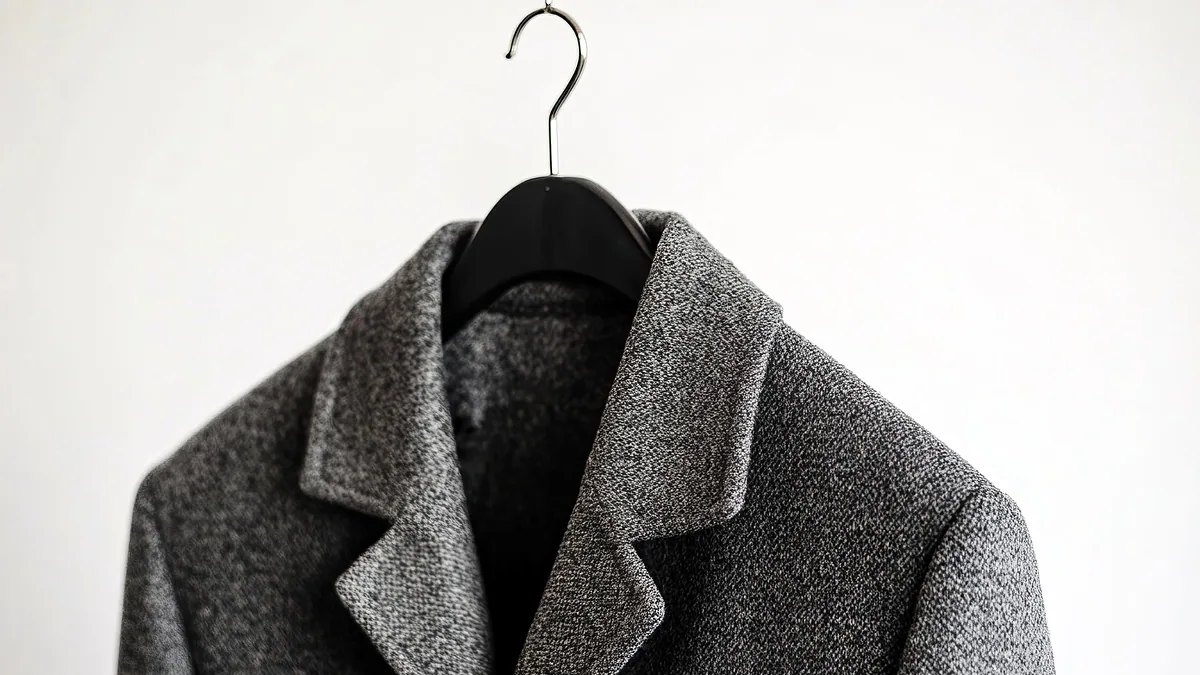
What a mohair wool coat is
The mohair wool coat is defined by that 2 fibre blend and by its job at the outer layer. Mohair alone makes a drapey, low weight fabric that feels light and moves beautifully, but the smooth hair has little crimp, so a pure mohair coat collapses on the shoulders and leaves air to leak past the seams. Wool alone holds a dense, springy structure that bounces back after bending, yet it is heavy and it clings. Blended, the two trade their weaknesses, and the coat reads as light on the body while the cross section stays thick enough to hold 2 to 3 layers of still air. That is the whole idea in one sentence.
How the fibre traps heat
Heat leaves the body by conduction, convection and radiation, and a coat fights all 3 by trapping air, because still air is a poor conductor and it holds heat close to the skin. Mohair earns its place in this fight through 2 physical traits that show up in the finished coat.
- Hollow core. The fibre runs with a thin, sometimes open, channel down its length, so the material has more air inside the fibre itself, which adds insulation at the same weight as a solid fibre.
- Low crimp and high loft. The nearly straight hair does not crush flat, so the weave or knit keeps its thickness and the air pockets between the yarns stay open.
The wool in the blend then adds density and a crimped spring, so the loft is locked in and the gaps between the mohair strands are closed. The result is a 2 to 3 layer air buffer that a plain wool coat of the same weight cannot match, because the plain cloth settles down and thins over a day of wear.
Why the outer layer is the right place
The outer layer has 2 jobs: it blocks the wind and it keeps the stack warm without trapping body heat, and the mohair blend meets both. The light drape means the coat does not press hard against the layers below, so the air you have already built up in the middle is not squeezed out of shape. The smooth mohair face also sheds light drizzle better than a fuzzy, high loft pile, and it resists the felted, pilled look that a brushed wool coat picks up at the cuffs after a season. When the coat sits on top, you get the warmth of the blend with the weather protection of a smooth, dense face, which is the combination a base layer could never provide, since a base layer must be thin and next to skin.
Mohair wool blend coat in practice
The blend ratio is where the coat is decided, and the 3 common mixes each suit a different use, listed from warmest to lightest.
- 50 to 50 mohair and wool: a balanced winter coat, thick enough for 4 to 10 C (40 to 50 F) and still light on the shoulders.
- 70 to 30 mohair and wool: the loftier, lighter option for 10 to 15 C (50 to 59 F), where the drape shows and the warmth is enough with a jumper below.
- 30 to 70 mohair and wool: the heavier, cheaper coat for below 0 C (32 F), where wool dominates and the mohair only adds loft.
The first 2 mixes are the ones most described as a mohair wool coat, because they keep enough mohair to hold the loft that the name promises. A coat sold at a high wool share is closer to a wool coat with a soft hand than to the lofted fabric the name suggests, so the ratio in the label is the number to check before you buy.
How a mohair coat compares to other warm fibres
The comparison is clearest as a table, because the differences sit in a few measurable columns: loft, weight, drape and the temperature band where each fibre stops being enough on its own.
| Fibre | Loft and structure | Best use in the stack |
|---|---|---|
| Mohair wool blend | High loft, light, smooth face, drapey | Outer layer at 0 to 10 C (32 to 50 F) |
| Merino | Medium loft, fine, crimped | Base layer, wicking and next to skin |
| Angora | Very high loft, fuzzy, low drape | Warm jumper or mid layer |
| Cashmere | Medium loft, soft, medium weight | Light mid layer or warm scarf |
The table keeps the 4 fibres in their natural places: merino next to skin, angora in the middle, and the mohair wool blend on top, each doing the job its structure is built for rather than the job a label claims for it.
Which fibre wins in which cold
The answer depends on the temperature band and on where in the stack the garment sits. The mohair wool coat wins as the outer layer from about 4 to 10 C (40 to 50 F), where its loft and drape beat a plain wool coat on warmth to weight. Below 0 C (32 F) it is not enough alone, and you add a heavier mid layer, because the coat blocks wind and holds the stack but does not add enough still air by itself. Above 10 C (50 F) it is more than the middle of the day needs, and a lighter merino layer or a shell takes over. So the fibre that wins is the one matched to the band and the layer, and for the outer layer in the mild cold band the mohair blend is the one whose structure fits the job.